
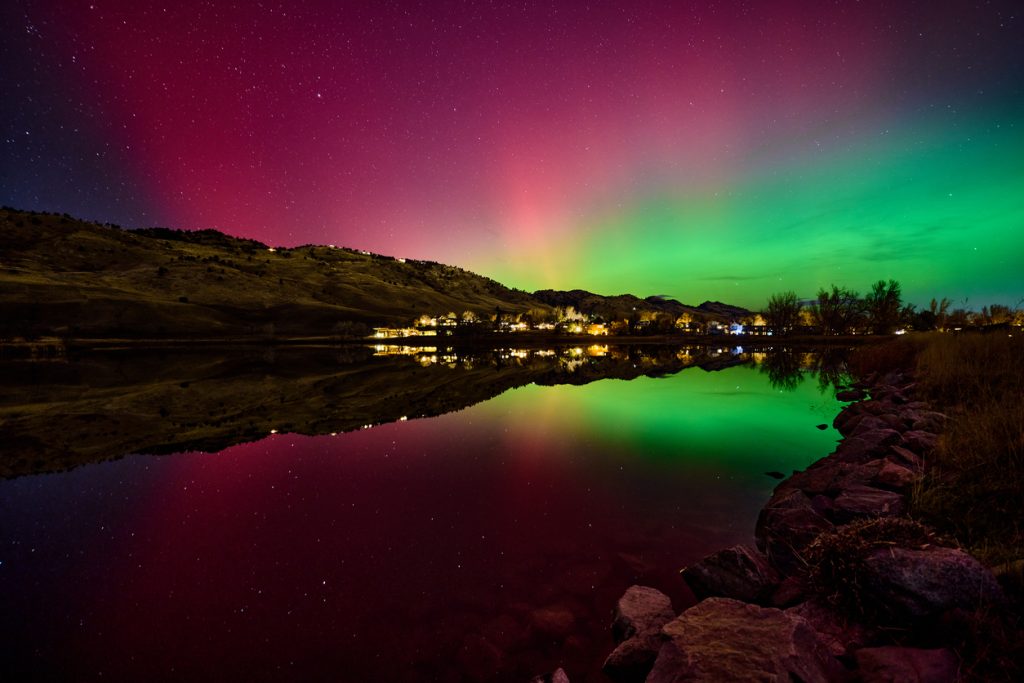
Seeing the northern lights in Colorado is rare and unpredictable, but far from impossible. Here’s what it takes.
Can you really see the aurora in Colorado?
Colorado sits around 40° north — normally too far south for reliable aurora. But during strong geomagnetic storms, the auroral oval expands southward, and Coloradans have photographed the lights from the mountains to the plains. Your odds are best near solar maximum (the active peak of the roughly 11-year solar cycle, which 2024–2025 delivered). One key tip: a camera captures far more color than the naked eye, which this far south often sees only a faint gray glow.
When to look
There’s no aurora “season,” but you improve your chances by watching the space-weather forecast. Follow NOAA’s Space Weather Prediction Center and aurora-alert apps for a high Kp index (roughly 7 or above for Colorado), then head out on a dark, clear, moonless night, generally between about 10 p.m. and 2 a.m. Fall through spring gives the longest dark nights.
Where to go
Get away from city lights and find an open view to the north. Colorado’s certified dark-sky areas are ideal — Great Sand Dunes and Black Canyon of the Gunnison are both International Dark Sky Parks — along with high mountain parks, reservoirs, and the open plains east of the Front Range. During the strongest storms, the lights have even been visible from the Denver–Boulder foothills.
Tips for catching (and shooting) the aurora
- Use a camera or phone night mode — a long exposure reveals pinks and greens your eyes can’t. Bring a tripod.
- Check the Kp forecast before driving out, and give your eyes 20 minutes to adjust to the dark.
- Dress warm — the best aurora nights are cold and clear.
- Be patient — displays come and go over minutes to hours.
Even without the aurora: Colorado’s dark skies
Aurora or not, Colorado has some of the darkest skies in the country. On a clear, moonless night the Milky Way is stunning from the mountains and Dark Sky Parks, and meteor showers put on a show. A guided astronomy tour is a great way to see it through real telescopes with an expert — or bring your own; see our stargazing gear guide.
Book onlineBook a Colorado stargazing tourSee galaxies, nebulae, and the Milky Way through telescopes with an astronomerBook now →Northern lights in Colorado FAQ
Can you see the northern lights in Colorado?
Yes, occasionally. Colorado is usually too far south for the aurora, but during strong geomagnetic storms the northern lights can be seen and photographed across the state. It is rare and unpredictable, most likely near solar maximum, and a camera captures far more color than the naked eye. During the 2024 and 2025 storms the aurora was widely seen in Colorado, including over Boulder.
When is the best time to see the aurora in Colorado?
There is no set season. Your odds rise near solar maximum and during strong geomagnetic storms with a Kp index around 7 or higher. Watch NOAA's Space Weather Prediction Center and aurora apps, then look on a dark, clear, moonless night, usually between about 10 p.m. and 2 a.m.
Where is the best place to see the northern lights in Colorado?
Anywhere with dark skies and an unobstructed view to the north, away from city lights. International Dark Sky Parks like Great Sand Dunes and Black Canyon of the Gunnison are excellent, as are high mountain areas and the open eastern plains. During the strongest storms the lights have been visible from the Front Range near Boulder.
Do you need a camera to see the aurora in Colorado?
It helps enormously. This far south the aurora is often faint to the naked eye, appearing as a pale gray glow, but a phone's night mode or a camera long exposure reveals the pink and green colors. A tripod makes a big difference.